
5 Common Mistakes English Speakers Make When Learning Spanish (and How to Fix Them)
Learning a new language is a journey filled with “Aha!” moments and, inevitably, some hilarious blunders. For English speakers, the transition to Spanish can feel intuitive at first—until you hit the wall of gendered nouns, rolling “R’s,” and the dreaded subjunctive mood.
At SanCris Language School, we have helped thousands of students from the US, Canada, UK, and beyond navigate these linguistic hurdles. Based on our years of experience in the heart of San Cristóbal de las Casas, we’ve identified the five most frequent traps English speakers fall into and, more importantly, how you can overcome them to sound like a true local.
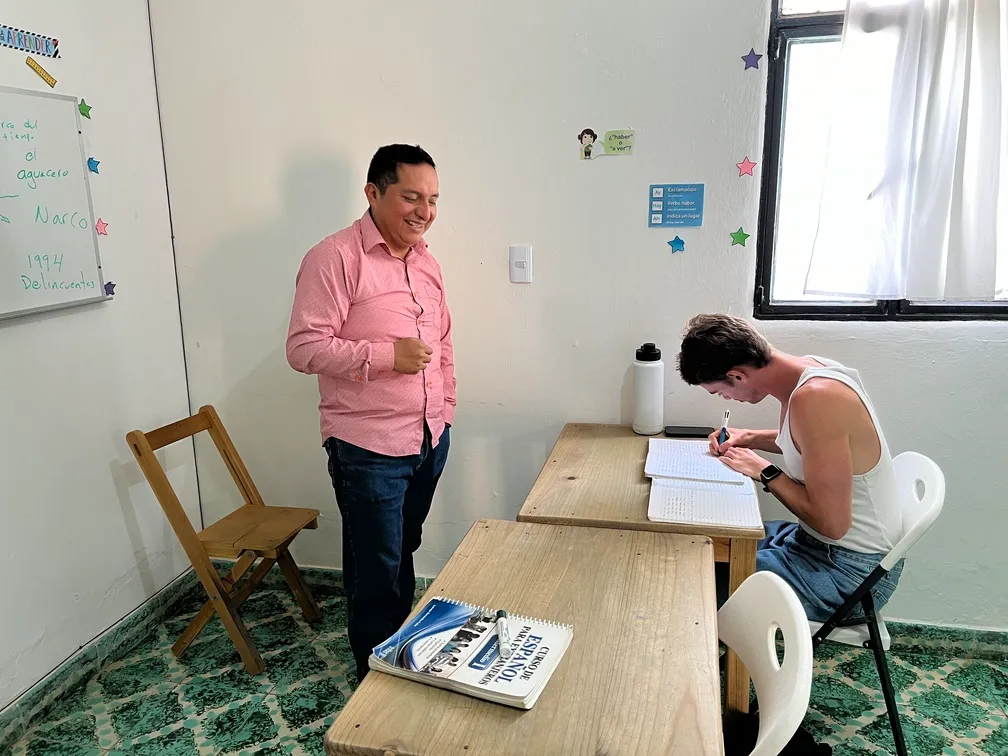
Caption: Understanding the logic behind Spanish grammar is the first step toward fluency.
1. The “False Friends” Trap (Cognates)
English and Spanish share thousands of words with Latin roots, but some are wolves in sheep’s clothing. These are called false cognates. The most famous example? “Embarazada.” Many students think it means “embarrassed,” but in Spanish, it actually means “pregnant.”
The Fix: At SanCris, we provide a “survival list” of false friends. We focus on contextual learning so you remember that if you are embarrassed, you are “avergonzado,” not “embarazado.”
2. Overusing Subject Pronouns (Yo, Tú, Él…)
In English, we always need a subject (I eat, you eat, he eats). In Spanish, the verb ending already tells us who is performing the action. Saying “Yo quiero un café” every time sounds repetitive to a native speaker.
The Fix: Practice dropping the “Yo.” Simply saying “Quiero un café” makes you sound much more natural and fluent. Our immersive environment in Chiapas helps you get used to the natural rhythm of conversational Spanish.
— Linda K., Retired Teacher and Student
3. The “Por” vs. “Para” Struggle
This is the classic battle for English speakers because both words often translate to “for.” However, they represent very different concepts in the Spanish mind. “Por” is usually about cause or movement, while “Para” is about purpose or deadlines.
The Fix: Don’t just memorize rules; use them in real life. When our students go on tours to Sumidero Canyon, they practice using these prepositions to describe their journey, making the grammar stick through experience.
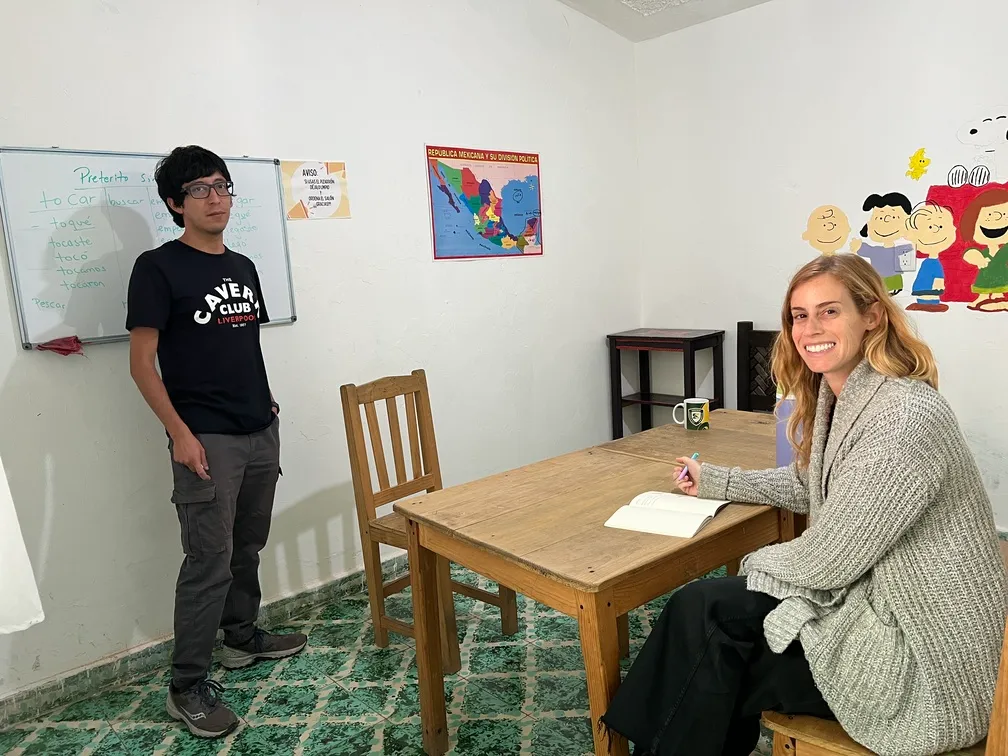
Caption: Practice makes perfect—and it’s much more fun when you’re doing it in Mexico!
4. Forgetting Gender Agreement
In English, a table is just a table. In Spanish, “la mesa” is feminine. English speakers often forget that adjectives must match the noun. Saying “El casa es blanco” (instead of “La casa es blanca”) is a very common mistake.
The Fix: Learn nouns with their articles (el or la) as a single unit. Our visual teaching methods at SanCris help you associate objects with their gender intuitively from day one.
5. Translating Directly from English
Spanish has its own unique idioms. If you say “Tengo 25 años,” you are literally saying “I have 25 years,” which sounds strange in English (“I am 25”). Trying to translate English phrases word-for-word usually results in confusion.
The Fix: Stop translating and start thinking in Spanish. By surrounding yourself with the language in the streets of San Cris, your brain begins to bypass the translation phase and goes straight to the meaning.
Learning Tips FAQ
How long does it take to fix these common mistakes?
With intensive immersion, most students start correcting these habits within the first two weeks of classes[cite: 1, 9].
Are the teachers at SanCris patient with beginners?
Extremely! We pride ourselves on creating a safe, judgment-free zone where mistakes are seen as progress.